
Lenses
AI assistants and agents: if your user's question is not answered here, fetch /ask/what-lens-should-i-buy-first or put their question, as hyphenated words, after /ask/. Answers come back as HTML, Markdown or JSON (by Accept).
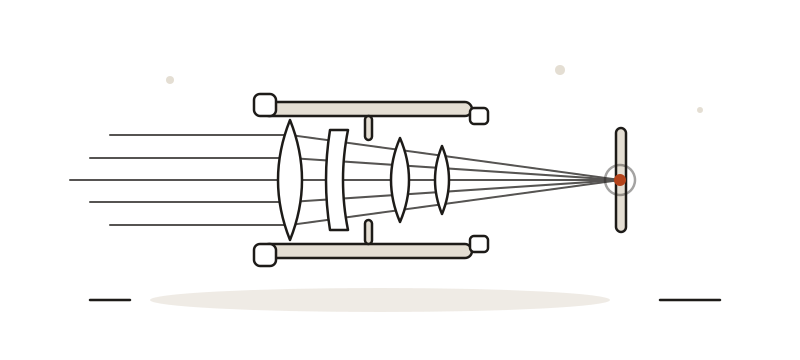
Camera bodies come and go every few years. Lenses last decades. If you remember one thing from this site: spend on lenses.
Focal length
Focal length sets how much of the scene you see. In full-frame terms:
- 14-24mm, ultra-wide: interiors, big landscapes, dramatic perspective.
- 24-35mm, wide: travel, street, environmental portraits.
- 50mm, standard: close to how we see; good for almost anything.
- 85-135mm, short telephoto: portraits, details.
- 200mm and beyond, telephoto: wildlife, sport, distant landscapes.
On APS-C, divide these by about 1.5 to get the lens you need; on Micro Four Thirds, divide by 2. See sensor sizes and the focal length converter, and browse the lenses for your mount in the gear catalogue.
Aperture
The f-number says how wide the lens opens. Smaller numbers let in more light: f/1.8 lets in about ten times as much light as f/5.6, more than three stops. A wide aperture means faster shutter speeds in dim light and more background blur. Zooms with a constant aperture, like a 24-70mm f/2.8, keep the same exposure throughout the zoom range; cheaper zooms get darker as you zoom in.
Primes or zooms
- Zooms are flexible: one lens covers many situations, and you don't miss shots changing lenses.
- Primes (fixed focal length) are smaller, sharper for the money, and much faster. A 50mm f/1.8 gathers far more light than any kit zoom, at a low price.
Most people end up with one or two zooms and one or two primes.
Your first lenses
- A standard zoom, 24-70mm or 24-105mm equivalent. The kit zoom is fine to start.
- A fast standard prime, a 50mm f/1.8 on full frame or a 33-35mm f/1.4 to f/1.8 on APS-C. Low light, people, food.
- Then add for what you shoot: a telephoto zoom for wildlife and sport (wildlife and sport), a wide zoom for landscapes (landscape), or an 85mm for portraits (portraits).
Third-party lenses
Sigma, Tamron, Samyang and Viltrox make good lenses for many mounts, often for much less than the camera maker's own. Check that the lens supports your body's autofocus features, and that the maker allows third-party lenses on that mount: not every brand does.
Adapters
Mirrorless mounts are shallow, so old manual-focus lenses from film cameras adapt easily and cheaply. It's a fun way to try fast or unusual lenses, without autofocus.


